
This week I am helping a client migrate their trusty old AS/400 to a shiny brand-new Power System in the Cloud – disclaimer “they call it an AS400, not me” 😉 This glorious old machine has been quietly running IBM-i V7R1, unattended in the corner of a darkened office for a decade. The system admin retired years ago, leaving the system lonely, ticking away unattended. Suddenly, a stormy summer night, a power cut crashes the machine, and it won’t power back up! Disaster looms. Panic, looking for tape backups that don’t exist, contacting IBM to be told “that is years out of support and we cannot help!” and I’m pulled into the mix. After hours of trying various recovering options, we finally succeed powering the machine up again, business is resumed. Phew! But, now it’s time for a remediation plan to prevent this happening again – this means diving straight into a plan to migrate, upgrade and support this system going forward. Come with my while I blog through this particular clients’ adventures while “Moving IBM-i to the Cloud”
I have spent enough years walking into computer rooms to know the smell. Warm air, a Power System humming in the corner, a tape drive that only works if you stroke it first, and a UPS that last had its batteries checked during the last World Cup.
If that machine is still yours, you already know the plot. Hardware refresh is due. The room is not getting any younger. The person who knew how to IPL it after a power blip is now “consulting” from a beach. And the board keeps asking why a business-critical ERP is sitting next to the kettle.
This is the post about the other option. A cloud-based IBM hosting solution. Real IBM i on real Power hardware. Same RPG, same CL, same Db2 for i. Different building. Different electricity bill. And a support contract that actually answers the phone.
I am partnering and recommending RZKH (you may know them as POWERbunker, or PUB400) to do the whole job. Not a slide deck and a handshake. The entire migration, then a full-service support contract covering backups, security configuration and monitoring, and system availability.
If you have a physical machine on site and you want it off the floor, this is the path I am offering.
First, what this is not
It is not “put the AS/400 on AWS and hope.” IBM i runs on IBM Power. Full stop. You cannot boot your production LPAR on an x86 virtual machine and call it a lift.
A proper cloud-based IBM hosting solution means:
- A real Power frame in a proper data centre
- Your workloads on an IBM i partition
- Network access that is planned, usually VPN, not a Telnet port waving at the internet
- People who have seen a job queue, a journal receiver, and a BRMS save before breakfast
RZKH have been doing that for years. Their production kit lives in a former Cold War fallout shelter in Germany, which is either the most on-brand IBM i hosting story I have heard or the best disaster recovery metaphor in the industry. Either way, it is actual Power, run by people who speak IBM i, not a generic “cloud engineer” who thinks QSYS is a typo.
Your applications do not need a five-year rewrite to get there. If you land on real Power, it is still IBM i. The programs compile the same way. The files are still files. The users still sign on with ACS. What changes is the building, the cooling, and who owns the 2 a.m. call.
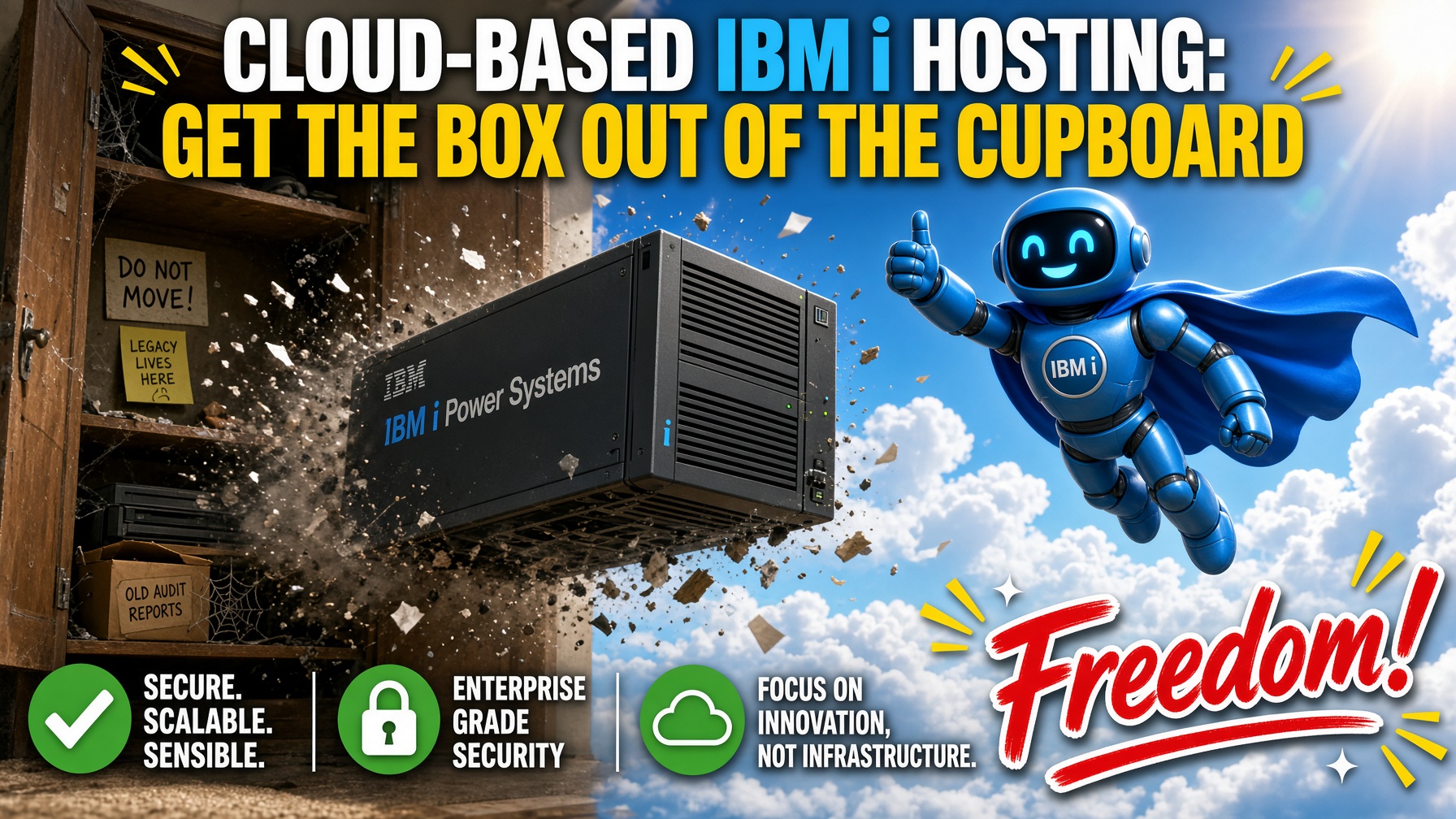
Why the physical box is quietly expensive
On-site iron feels cheap because the invoice for the frame already happened. Then the rest of the iceberg turns up.
Hardware refresh. Power systems do not live forever. When the box is out of support, spare parts become a treasure hunt and IBM SWMA starts making faces.
Power, cooling, and the room itself. That computer room is not free. Air con, UPS batteries, fire suppression, raised floor, and the landlord who suddenly cares about “that noisy cupboard.”
Tapes, offsite boxes, and the person who drives them. Backup is only a backup if it restores. A shelf of LTO cartridges and a “we take them home on Friday” process is not a strategy. It is folklore.
Security configuration that never quite gets finished. User profiles with *ALLOBJ because it was quicker. Telnet still on. *PUBLIC *CHANGE on a library nobody remembers. Audit journals that fill a disk and then get ignored. On a box you walk past every day, this feels like next month’s job. Next month never arrives.
Availability. One frame, one site, one set of disks. That is fine until it is not. High availability on-prem means a second box, a second room, and someone who can run a switchover without a spreadsheet and a prayer.
Skills. IBM i operators are not growing on trees. If your last sysadmin is also your last RPG person, you do not have a succession plan. You have a single point of failure in a cardigan.
Add those up over three years and the “we already own the machine” argument starts to look like a rounding error.
What you actually buy for a low monthly fee
A fully monitored cloud IBM i solution, for a typical mid-size production partition, typically lands in the $2,000 to $3,000 per month range. That is not a toy LPAR and it is not a Fortune 500 private cloud. It is the band most companies with a single physical Power box should be comparing against.
What that monthly figure is meant to replace:
- The next hardware refresh
- IBM-i Operating System fixpacks, service packs and regular PTF’s
- Power and cooling
- Tape hardware, media, and offsite handling – regular backup and restore strategies
- Weekend and overnight cover
- Security hardening that someone else actually does
- Monitoring that is not “Jim checks WRKACTJOB when he remembers”
- A building that is not your broom cupboard
You swap capex and surprise for opex and a contract. Cashflow gets simpler. Finance stops asking why you need a new frame every few years. You still need to size cores, memory and storage properly. Cloud is not a magic discount machine. It is a different cost shape, and for most shops with ageing iron it is the cheaper shape once you count the whole iceberg.
If your current “strategy” is one old iSERIES 520 in a plant, a tape rack that may or not be working, a few PC’s with 5250 emulators… a hope and a prayer for continued uptime then a simple monthly payment for peace of mind is not a luxury. It’s a necessity, and it’s way cheaper than the outage you have not had yet.
The partnership: I get you there, RZKH takes care of hardware and then me (and my team) monitor the system daily to keep it on its toes.
Migrations fail in the gaps. The hoster assumes you will save and restore it yourself. The consultant assumes the hoster will “just copy the LPAR.” The business assumes Saturday night is a good time because “nobody uses the system then,” which is adorable if you have ever met a night-shift warehouse.
So the offer is the entire path, not two half-jobs taped together.
1. Assessment. What is on the box. IBM i release. Licensed cores. Disk, IFS, and save size. Change rate. Printers, EDI, bank files, IP addresses burned into CL, ISV keys tied to a serial number, and the PC that still thinks Client Access is a personality trait. We measure that before anyone books a weekend.
2. Target design. Partition size, storage, network, VPN (site-to-site for the office, client VPN for the sofa developers), backup policy, and whether you need a second LPAR for HA or DR. Same workloads. No rewrite salesman invited.
3. Migration. Save and restore still works. BRMS still works. For bigger systems we plan around data size, bandwidth and an agreed RPO and RTO. Fallback is part of the plan, not a Slack message at 11pm. Users should see the same system with a different address.
4. Cutover and prove it. Sign-on, batch, interfaces, printers, backups, and a restore test that is not theoretical. If we cannot restore it, we did not back it up. We just made a hobby of copying bits.
5. Full service support contract. This is the bit that makes the monthly fee worth having.
Backups
Scheduled saves, media that is not in the same room as production, and restore tests that happen on purpose. Journal receivers managed like adults. If you need virtual tape or replication to a second site, that is designed in, not bolted on after the first scare.
Security configuration and monitoring
The partition is not left on default. User profiles, *PUBLIC authorities, network attributes, exit points, TLS for 5250, and no wide-open Telnet hanging off the public internet. Then monitoring, so a full disk, a failed save, or a partition that has gone quiet is someone else’s pager, not yours at 3 a.m.
I have written recently about VPN for cloud IBM i access. That still applies. The family jewels do not sit on a public port. Staff connect through a tunnel, then ACS and SSH talk to a private address, same as they did when the box was down the corridor.
System availability
The hoster owns the building, the Power frame, the cooling and the network path. The support contract owns the operational side: is the partition up, are the jobs running, did last night’s save complete, is anyone looking at QSYSOPR. You get a system that is supposed to be available, with people whose job is to keep it that way.
You still own the application. Your RPG, your data, your users, your change control. Cloud does not invent a spare programmer. It does take the iron, the room and the “who is watching the box” problem off your desk.
Cloud versus the machine you can point at
| On-site physical Power box | Cloud-based IBM i hosting with support |
|---|---|
| You own the refresh cycle | Provider owns the frame and refreshes it |
| You own power, UPS, air con | You own a monthly invoice |
| Backup is whatever you set up | Backup is in the contract |
| Security is “when we have time” | Security config and monitoring are the job |
| One building, one set of disks | Data centre, monitoring, availability as a service |
| Skills walk out the door | IBM i people are on the other end of the contract |
| Capex plus surprises | Typically 2 to 3k a month (obviously your mileage will vary), fully monitored |
The users should not care. That is the test. If payroll, picking and invoicing look the same on Monday, we did it right. The only person who should notice is the one who used to change tapes.
Who this is for
- You are still running a physical Power System (yes, even if everyone still calls it the AS/400)
- The box is out of support, or the next refresh makes Finance twitch
- You do not have a deep IBM i operations bench
- You want the applications left alone and the infrastructure taken off-site
- You would like one partner path from “that machine in the room” to “that partition in the cloud,” then a support contract that covers the boring, vital work
It is less ideal if you already have a strong internal IBM i team, two sites, and a refresh budget you are happy with. Cloud is a tool. It is not a religion.
What happens if you want to talk
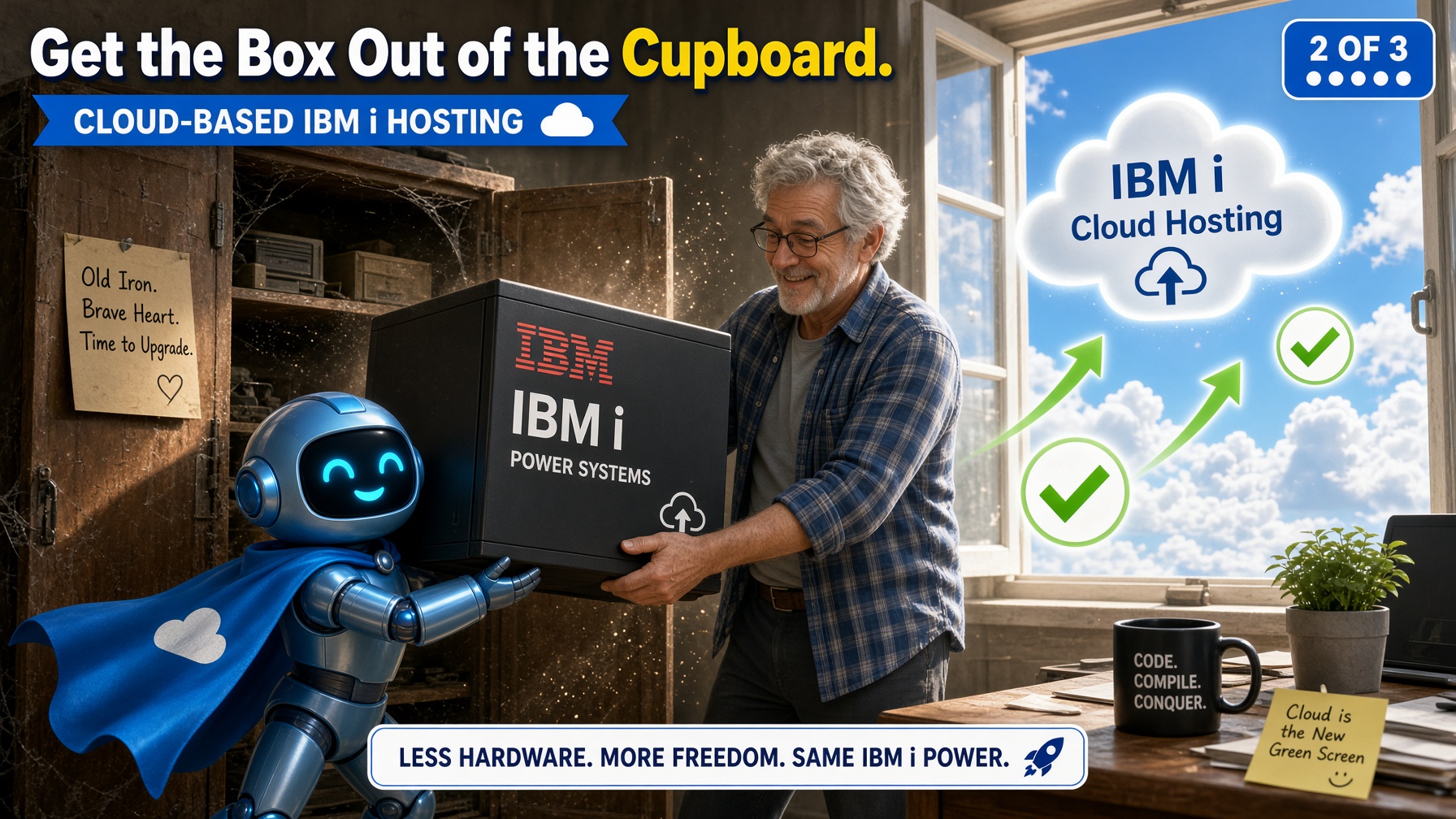
You do not need a rewrite programme to leave the computer room. You need a measured move onto real Power in a proper facility, a network design that is not embarrassing, and a support contract that covers backups, security and availability.
That is what I am offering in partnership with a solid, professional and proven cloud host. I help you through the whole migration. They host it on IBM i specialist infrastructure. Together we leave you with a monitored cloud partition instead of a warm box next to the kettle.
If that sounds like your next three years, get in touch. Bring the serial number, the IBM i release, a rough idea of disk and save size, and the honest answer to “who takes the 2 a.m. call today.” We can work out whether 2 to 3k a month is cheaper than keeping the cupboard. Need something less? Something more? Glad to point you in the right direction and get you there!
Spoiler: Moving to the cloud usually is easier than you thought and provides better peace of mind. The old system in the cupboard never sends an invoice for the weekend it nearly crashed, nobody noticed and the business went to its knees. How much is your peace of mind worth?
